Untold Stories
May 2026 · Published in Zerb, the journal of the Guild of Television Cameramen
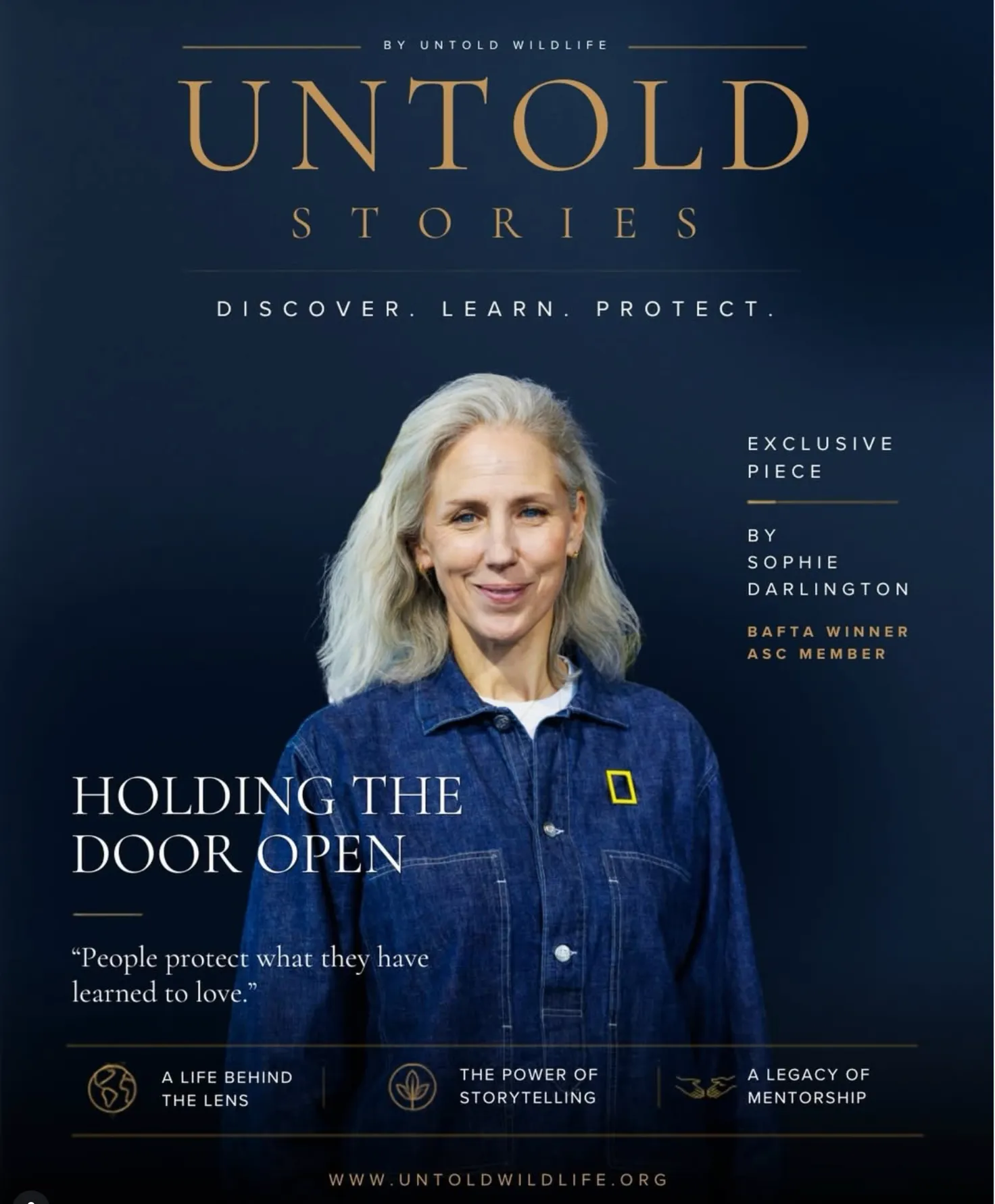
There is a moment, early on in your career, when you realise no one is going to hand you a camera and say: here, this is yours now.
You have to find your way in. And in wildlife filmmaking, for most of the thirty-odd years I have been doing this, that way in has been narrow, unmarked, and largely invisible to anyone who didn't already know it was there.
I moved to Tanzania at nineteen. Not because I had a plan — I didn't — but because the bush was where I wanted to be and I followed that pull without overthinking it. What I found there was a world that rewarded patience, attention and the willingness to sit in the dark for hours watching for something you might never see. Those are useful qualities for a cinematographer. They are not, it turns out, qualities that are especially valued when you first walk through the door.
For a long time, I was the only woman working in the field as a dedicated wildlife DoP. I didn't think of it as a distinction — it was simply how things were. The industry was male-dominated in the way that many industries were in the nineties: not by design, exactly, but by default. Nobody said women couldn't do it. Nobody said much at all. They just didn't.
The question I get asked most often now — particularly by women starting out — is some version of: how did you manage it? And I never quite know how to answer, because the honest answer is that I didn't manage it so much as refuse to leave. Stubbornness is underrated as a professional strategy.
But something has shifted. The conversation around women behind the camera in wildlife film has moved from theoretical to practical. There are more of us. Not enough — not nearly enough — but more. And the question has changed from whether women can do this work to how we make sure the next generation finds its way in more easily than we did.
That is the question I find myself thinking about most. Not how I got here, but who else should be here and isn't yet. Who is sitting somewhere right now with exactly the right instincts for this work — the patience, the attention, the willingness to be cold and still and wrong and try again — and has no map, no mentor, no indication that a door even exists, let alone that it might open for them.
Holding that door open is not complicated. It looks like answering emails from students. It looks like saying yes to the conversation at the festival, the panel, the talk. It looks like being visible in a way that isn't about self-promotion but about evidence — evidence that someone like you can do this, has done this, is still doing this.
It looks like telling the truth about the unglamorous parts: the shoots that go wrong, the footage you don't get, the years when the work is thin and the doubt is loud. Because the mythology of this career — the extraordinary images, the extraordinary locations — can make it seem like success arrives whole and sudden, when in fact it arrives in fragments, over decades, through a kind of accumulated stubbornness that doesn't read as heroic while you're living it.
I was invited to join the American Society of Cinematographers last year. It is an honour I did not anticipate, and I am still slightly startled by it. The ASC has a long and distinguished history; I am the first dedicated wildlife DoP to be included in its membership. What that means, practically, is that the work of wildlife cinematography has been recognised as sitting fully within the larger discipline of cinematography — not as a specialist offshoot or a nature-documentary niche, but as the real thing.
I mention this not as a trophy but as a data point. Thirty years ago, the idea would have been inconceivable. Not because the work wasn't worthy of it, but because nobody was looking in that direction. Things change when people keep doing the work, keep showing up, keep refusing the idea that they are peripheral to a story that is partly theirs.
The untold stories are not just the ones we haven't filmed yet. They are the careers that haven't started because no one made it clear they could. That is the part worth working on.